
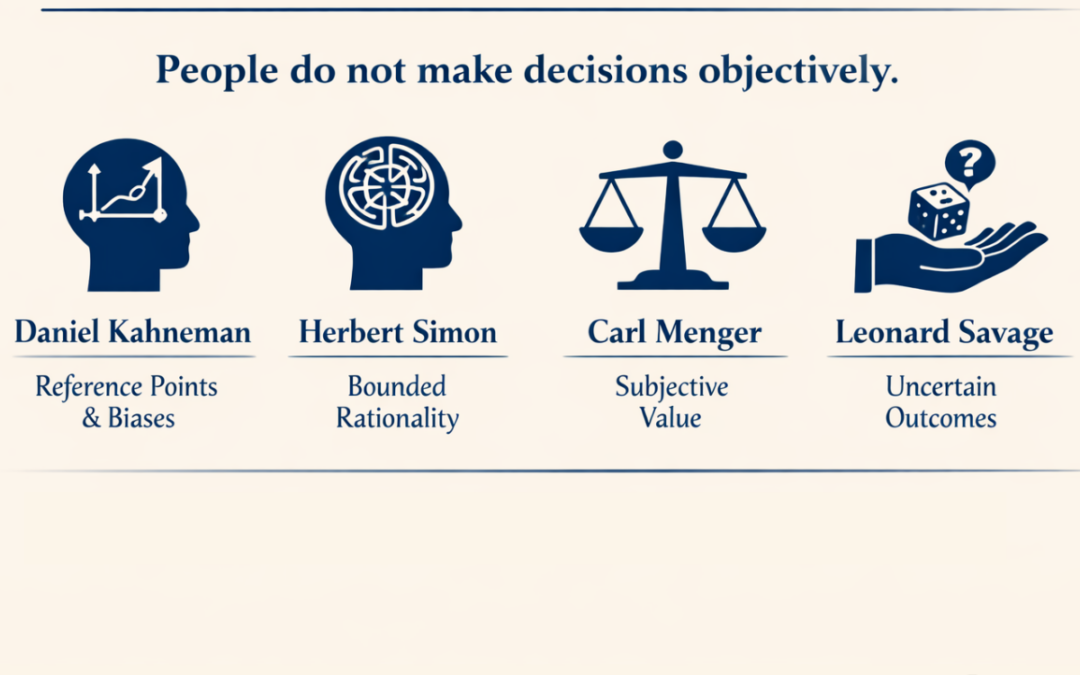
Kahneman, Simon, Menger, and Savage converged on something that is foundational to marketing, but not thought of enough:
People don’t make decisions objectively.
They don’t evaluate products in isolation or compute stable value. They interpret, compare, and guess, placing probabilistic bets with limited time and information. Action doesn’t occur when value exists. It occurs when perceived value clears a threshold.
So what shapes perceived value?
Real benefits and costs exist, but customers don’t experience them in isolation. To understand total value, we must recognize that perceived benefits combine real benefits with mental, social, and emotional benefits. The same is true for costs.
This explains why identical offerings are valued differently at decision moments and why mental and emotional factors can dominate the decision entirely.
A product with superior real benefits can lose to one with inferior performance but lower cognitive load, stronger identity alignment, or better social proof.
This is foundational to understanding why people choose at all.
These effects primarily shape Perceived Benefits, Perceived Costs, and Belief, not thresholds directly. They determine whether real value is felt strongly enough to reach them.
Mental, social, and emotional factors are context-dependent and vary widely: identity alignment, social validation, processing effort, familiarity, cognitive load, emotional reassurance, fear of regret, narrative clarity, status implications, and many others. We should understand these factors and consider which ones are influencing decisions.
A few well-documented patterns illustrate how this works:
Perceived Benefits:
Prospect Theory – Outcomes are evaluated relative to reference points, not absolutely
Diminishing Sensitivity – First improvements carry the most weight; additional gains fade fast
Identity & Self-Signaling – Choices create psychological benefit beyond functional outcomes
Two options can deliver the same result and still feel very different.
Perceived Costs:
Bounded Rationality – Effort, complexity, and cognitive load are experienced as real costs
Ambiguity Aversion – Unclear risks inflate perceived downside
Loss Aversion – Potential losses weigh more heavily than equivalent gains
Many decisions fail not because value is low, but because perceived friction is high.
Belief:
Belief isn’t persuasion. It’s perceived likelihood of success.
Authority & Expertise Heuristics – Competence signals substitute for full evaluation
Social Learning – Observing others reduces uncertainty
Processing Fluency – Ease of understanding increases confidence
Without belief, even real benefits and low costs fail to motivate action.
The Bottom Line:
Behavioral research doesn’t replace fundamentals, guarantee action, or override structure.
It explains how value is evaluated, not how decisions are made.
That requires decision science.
That’s where the next post goes.
The Behavioral Research That Shapes Perceived Value
Recent Comments