
Growth stalls when decisions default to inaction, even when value is strong.
In earlier posts, I covered two prerequisites for action:
– How people assign value
– What threshold that value must clear
These are necessary but not sufficient. Value and threshold-crossing create the potential for action. But additional constraints determine whether that potential converts to behavior.
This isn’t about persuasion tactics. It’s about the mechanical constraints that prevent decisions from completing.
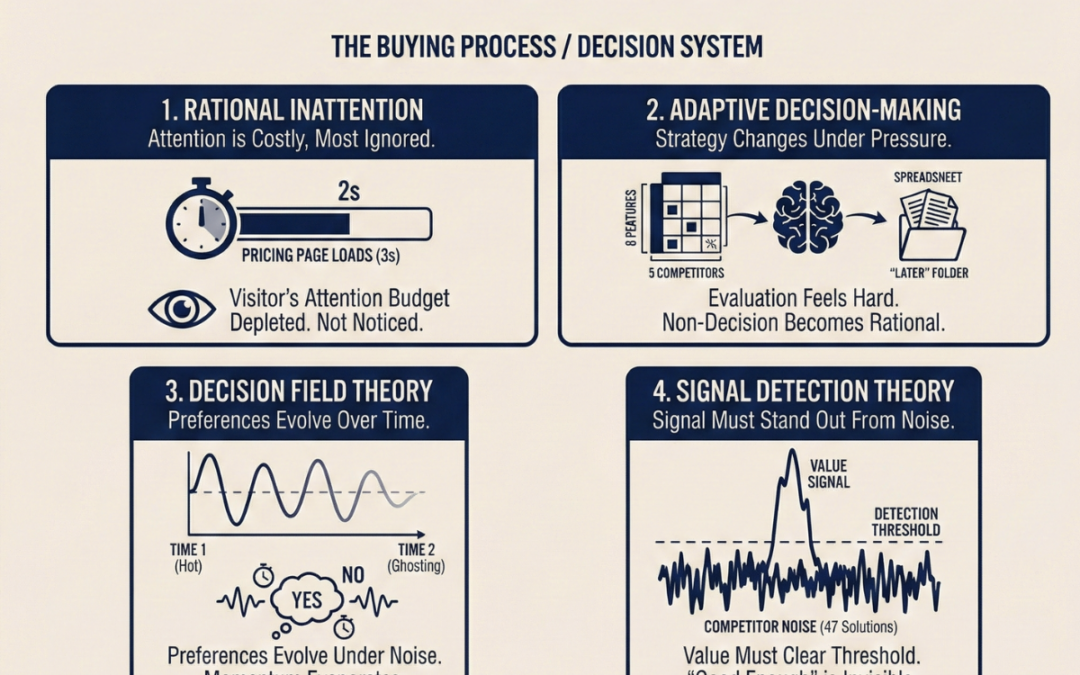
The buying process involves a series of decisions. Progress depends on how each one settles. The theories below are not stages. They are ways of explaining how different pressures act on the same decision system.
Rational Inattention – Attention is costly. People assess whether further evaluation is worth the effort. If it is not, evaluation stops early and value is never fully understood.
Adaptive Decision Making – People change decision strategies under time and effort constraints. When evaluation feels hard, deferral or inaction becomes rational.
Decision Field Theory – Preferences are not fixed. They evolve over time under noise, which explains hesitation and delay.
Signal Detection Theory – Action occurs only when a signal stands out from noise. Value must cross a threshold in context to lead to action.
Many growth problems are misdiagnosed. Teams update creative when the real problem is noise. They cut prices when the issue is evaluation effort. They manufacture urgency when the decision was never fully noticed.
Growth often stalls not because value is absent, but because decisions settle into inaction.
Decision science helps identify where that settlement happens before teams optimize the wrong variable. The solution isn’t louder messaging, it’s reducing the constraints that prevent evaluation, preference formation, and signal detection.
Four Decision Constraints That Explain Why Growth Stalls
Recent Comments