
Most marketing frameworks describe what people do.
Funnels. Journeys. Stages.
What they often miss is the most important part: those journeys are made by humans making decisions.
People with emotions, goals, expectations, and something at stake.
People who are distracted, constrained, and operating under uncertainty.
That does not mean decisions cannot be understood, but it does mean they cannot be understood as mechanical processes.
Decision science asks a more basic question: why does a choice happen at all?
Across economics, psychology, and decision theory, the pattern is consistent:
Action occurs only when a choice feels worth it in that moment.
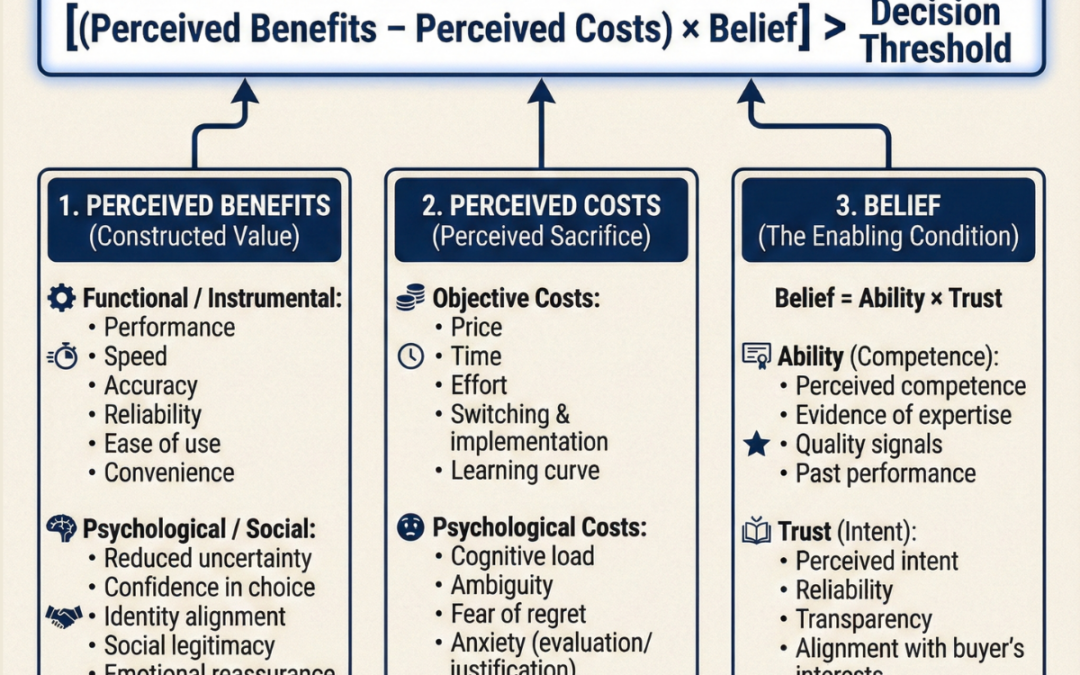
A simple way to express that condition:
A decision happens when perceived benefits outweigh perceived costs, adjusted for belief, and clear a decision threshold.
This is not a predictive model.
Human decisions are too complex for that.
It is a heuristic. A way to diagnose decisions under uncertainty, limited attention, and incomplete information.
The Four Inputs Behind Every Decision
Not because people calculate them, but because action does not occur unless these conditions are resolved in the decision.
1. Perceived Benefits
Benefits are constructed, not inherent.
They include functional outcomes, but also psychological and social payoff.
Two options can deliver the same result and still feel very different.
2. Perceived Costs
Costs go far beyond price.
Time, effort, learning, risk, ambiguity, and even the effort to decide itself.
Many decisions fail because friction is high, not value is low.
3. Belief (the enabling condition)
Belief determines whether benefits and costs even matter.
A useful shorthand:
Belief = Ability × Trust
Without belief, value does not activate action.
4. Decision Threshold
Action only happens when value clears a threshold.
That threshold shifts with risk, urgency, context, timing, and noise.
This is why interest does not always become action.
How to Use This
You do not address everything at once.
Decisions typically fail because one constraint dominates at the moment of choice. This is the factor that would unblock action if improved, even while other weaknesses remain.
The job is diagnostic: Which constraint is binding here?
Why This Applies Everywhere
Attention, consideration, clicking a link, requesting a demo, choosing a vendor, renewing, referring.
These are not stages.
They are decisions under uncertainty.
Next posts will dig into the behavioral tools and decision science that shape each of these inputs.
A Practical Decision Heuristic
Recent Comments